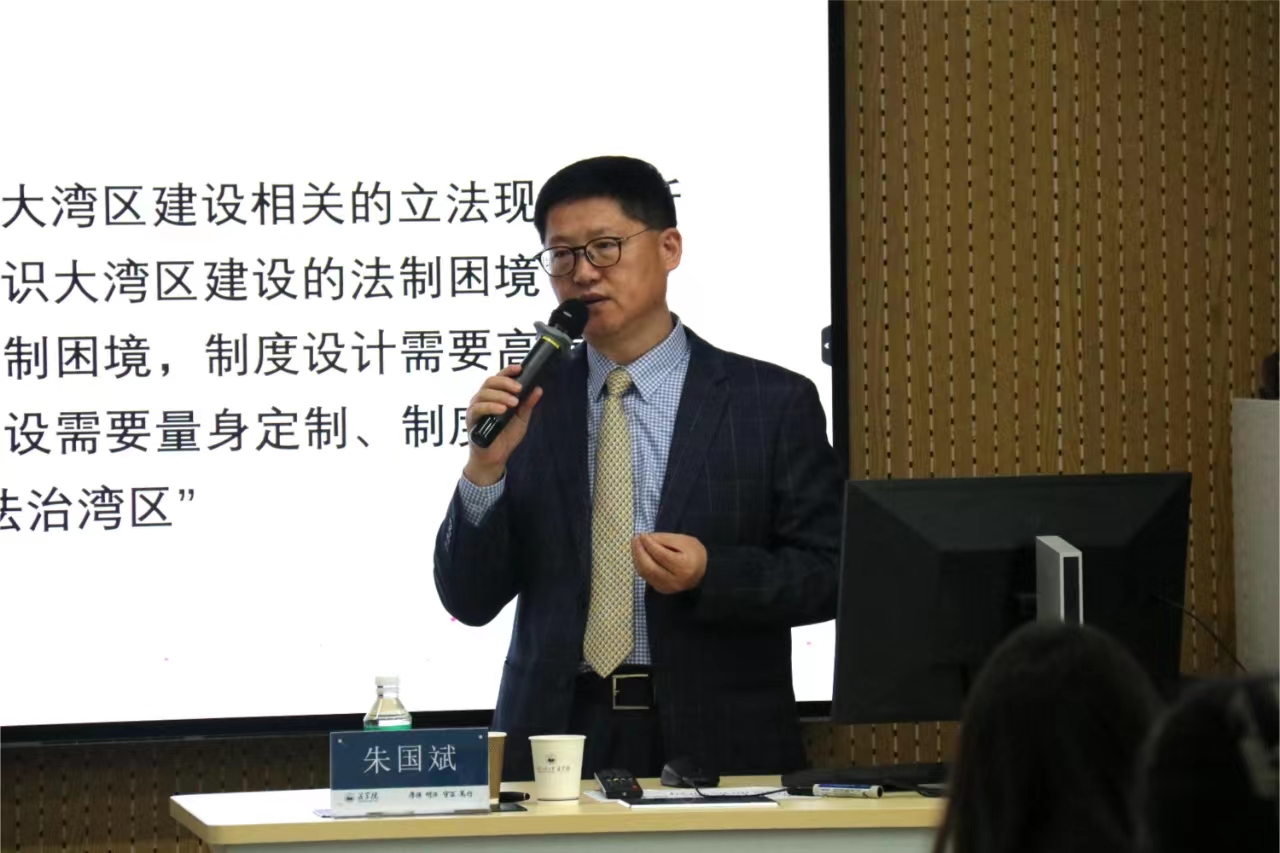
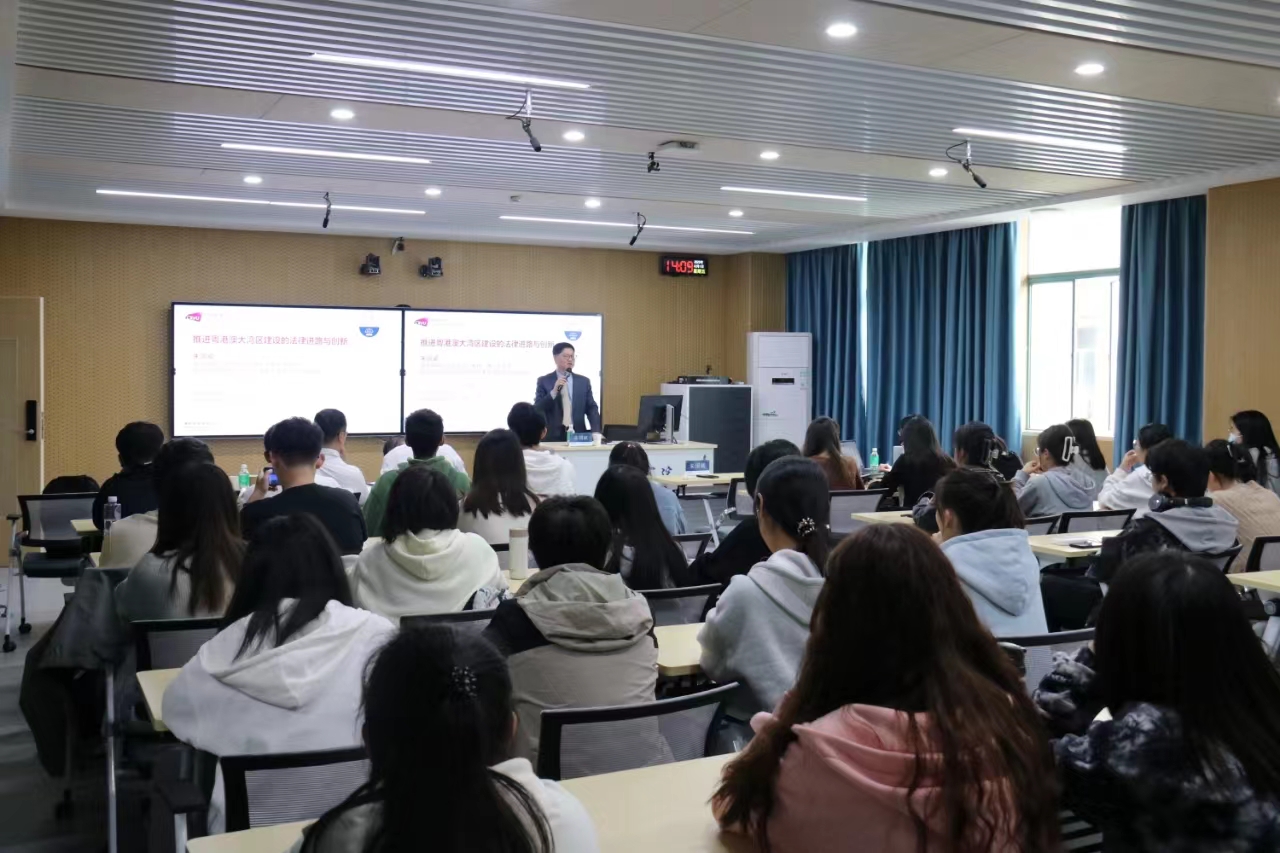
On December 1, Professor Zhu Guobin, a doctoral supervisor and professor at the School of Law of City University of Hong Kong, was invited to our school for academic exchange, delivering a brilliant lecture entitled "Legal Approaches and Innovations in Advancing the Construction of the Guangdong-Hong Kong-Macao Greater Bay Area." The lecture was moderated by Professor Li Zhiming, Associate Dean of the School of Law. Professor Qian Jinyu, a Distinguished Professor under our university's "Hundred Talents Program," served as a discussant. More than 40 faculty members and students, including Professor Chen Youwu, Dean of the School of Law, attended the lecture.
Professor Zhu first introduced basic concepts such as bay areas, the Guangdong-Hong Kong-Macao Greater Bay Area, and regional economic cooperation, as well as the origins of the Greater Bay Area concept. He then analyzed the current legislative landscape related to the construction of the Greater Bay Area, highlighting the characteristics of the central government's development plan and local legislation. In this regard, Professor Zhu emphasized the need to objectively recognize the legal and institutional challenges facing the Greater Bay Area's development, noting that institutional design requires a top-level perspective. He suggested possible breakthroughs such as establishing a centrally-led permanent administrative body, building a long-term legislative coordination mechanism, implementing a governance model that combines both "hard law" and "soft law," and creating new conflict resolution mechanisms. Finally, Professor Zhu advocated for building a "Rule-of-Law Bay Area" based on both "hard" and "soft" indicators.
During the discussion, Professor Qian Jinyu remarked that Professor Zhu's lecture directly addressed the structural obstacles and bottlenecks facing the construction of the Greater Bay Area, exploring high-quality development pathways under the principle of "upholding the One Country principle while respecting the differences of Two Systems; safeguarding the foundation of One Country while leveraging the strengths of Two Systems." The lecture demonstrated a high level of political awareness, theoretical integrity with innovation, and a strong sense of responsibility. Through this lecture, the attending faculty and students gained a deeper understanding of the current status and challenges of the Greater Bay Area's development, sparking profound reflections and greatly stimulating academic interest in research on the rule-of-law construction of the Greater Bay Area.